Tow‑Behind Vs Self‑Propelled Articulated Boom Lift: Which One Is Right For Your Project?
When planning aerial‑work projects, many buyers struggle to decide between a tow‑behind boom lift and a self‑propelled articulated boom lift. Both boom‑type aerial platforms lift operators to elevated work positions, yet they differ significantly in applicable working conditions, overall costs and site requirements. Picking the correct model saves substantial time and budget. A poor selection may result in situations where equipment cannot access the jobsite, fails to reach required heights or delivers unsatisfactory working productivity.
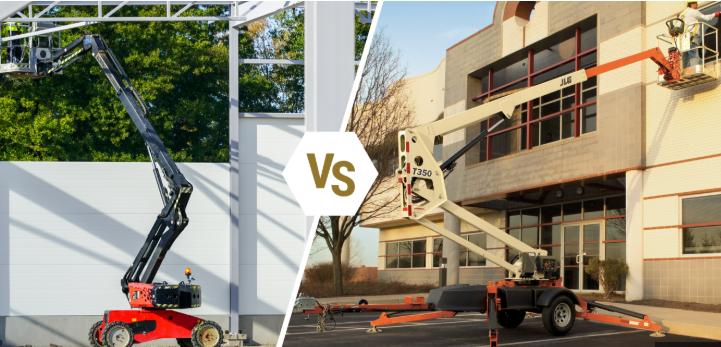
Tow‑Behind Articulated Boom Lift (Trailer‑Mounted Boom Lift)
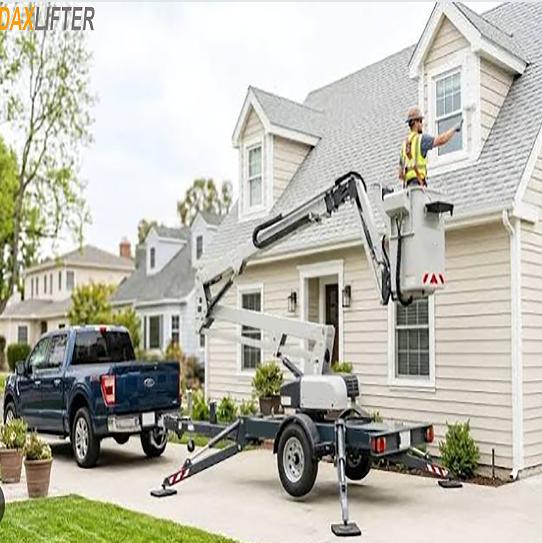
Built with an integrated trailer chassis, this boom lift can be towed by standard pickup trucks or SUVs for site‑to‑site relocation. Compact overall dimensions combined with multi‑joint articulated boom design allow both indoor and outdoor operation. Typical working heights range from 9 m to 21 m. It is well‑suited for scattered maintenance assignments, exterior wall painting, door‑window installation, billboard & lighting fitting, factory roof inspections and small‑scale building renovations. The hinged boom adjusts at multiple angles to access offset work‑points unreachable by straight‑vertical lifting equipment. Its stable work platform supports one or two operators carrying hand‑tools for overhead tasks.
Advantages
-
Flexible relocation: Light‑weight unit can be towed by any vehicle fitted with a trailer hitch. Easy movement across multiple job‑sites without costly flat‑bed truck transport, keeping cross‑project mobilisation expenses low.
-
Wide application range: Works indoors and on hard‑paved outdoor surfaces. Multi‑angle boom articulation easily reaches offset locations such as roof eaves and outer wall surfaces.
-
Lower investment: More affordable purchase and rental rates. It eases capital pressure for mid‑small contractors, maintenance companies and rental‑fleet operators with faster return‑on‑investment cycles.
Limitations
-
Restricted maximum working height and horizontal outreach, generally capped at 21 m. Not fit for large‑scale projects requiring extreme reach.
-
Demanding ground‑surface requirements. Must operate only on hard, solid and level pavement. Do not deploy directly over dirt, soft soil or pitted ground. Always verify ground load‑bearing capacity before use. Fully extend and level all outriggers to prevent overturning hazards.
-
Limited platform rated capacity. Never overload. Distribute tools and materials evenly to avoid offset loading risks.
Self‑Propelled Articulated Boom Lift
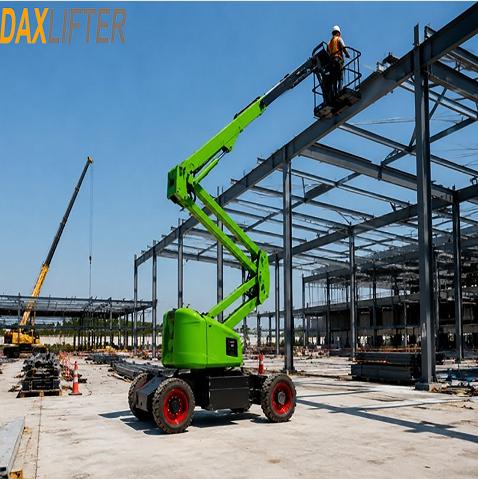
A self‑propelled articulated boom lift comes with an on‑board drive chassis. Operators can drive the whole machine directly from the platform basket. Its biggest highlight is outstanding obstacle‑surmounting capability. Multi‑segment hinged boom sections manoeuvre around steel beams, walls and trees to reach work‑points situated behind barriers. Working‑height options cover a broad spectrum from 9 m up to 45 m and above. Widely‑used for large curtain‑wall projects, factory steel‑structure inspections, big‑venue maintenance and high‑rise building exterior construction. Rough‑terrain variants travel and operate over unhardened uneven construction‑site ground.
Advantages
-
Superior obstacle‑clearing performance: Multi‑joint articulated boom bypasses intermediate obstructions and positions precisely at elevated work locations, delivering notable strengths on complex‑structure building sites.
-
Rich working‑height selections and large horizontal outreach, satisfying high‑floor and long‑reach overhead‑work demands.
-
Convenient on‑site mobility. Travel freely around the jobsite with outriggers retracted; no separate trailer required. High efficiency when switching work‑points across large‑area sites. Rough‑terrain models adapt to raw construction‑site ground conditions.
Limitations
-
Higher purchase and rental costs. Units of equal working height demand significantly bigger budget compared with tow‑behind boom lifts.
-
Heavier overall weight plus wider outer dimensions create difficulties accessing narrow aisles and compact yards. Non‑rough‑terrain versions still cannot run on soft ground.
-
Subject to rated platform load limits; overloading of personnel or cargo is prohibited.
Core Comparison Of Key Specifications
-
Transport & Relocation: Tow‑behind boom lift relies on vehicle towing; simple short‑distance multi‑site transfer with low hauling expense. Self‑propelled boom lift moves freely within the jobsite, yet requires flat‑bed trailers for transportation between different project locations due to heavy unit weight.
-
Working Height & Reach: Tow‑behind: 9‑21 m, best for medium‑low‑height jobs with moderate horizontal extension. Self‑propelled articulated boom lift: 9‑45 m+, multi‑angle boom articulation delivers stronger obstacle‑surmounting and long‑reach performance.
-
Stability: Tow‑behind models achieve stability via levelled outriggers; relatively light machine weight calls for strictly qualified ground conditions. Self‑propelled units feature heavy‑duty chassis for better overall stability and improved offset‑load resistance at identical working heights.
Selection Summary
Choose a tow‑behind boom lift if your projects feature medium‑or‑low working heights, scattered work‑points, frequent site transfers, limited budgets and hard‑levelled ground conditions. It brings excellent cost‑effectiveness and hassle‑free relocation.
Go for a self‑propelled articulated boom lift for large‑scale projects requiring great working heights, sites full of physical obstacles, frequent in‑site repositioning and complex ground environments. Its obstacle‑bypassing and high‑reach capabilities cannot be matched by tow‑behind units.
Critical Aerial‑Work Safety Reminders
Whichever boom lift you select, always perform full jobsite surveys before operation. Prior to startup, inspect that all four outriggers are fully extended and properly levelled with zero ground‑subsidence risk. Check hydraulic hoses for abrasion and oil leakage to eliminate hidden faults. Strictly comply with platform load limits during operation; over‑loading and offset‑loading are forbidden.
Reach out to DAXLIFTER customer support to obtain complete datasheets covering working height, rated capacity and power configurations. We provide exclusive quotation packages tailored to your site conditions and unit quantities. Whether you are buying for the first time, replacing old equipment, ordering bulk units or requesting non‑standard custom builds, our technical advisors deliver one‑on‑one selection support to match you with optimal boom‑lift models.
Safety comes first in aerial‑work operations. Suitable equipment guarantees smooth project progress. DAXLIFTER specialises in aerial lifting machinery, supplying reliable products and end‑to‑end technical support.
Get Custom Boom Lift Project Solutions From DAXLIFTER
WhatsApp / Phone: +86 15192782747
Email: sales@daxlifter.com
Tell us about your jobsite environment, required working height and quantity requirements, and receive detailed datasheets plus exclusive project quotations!