When businesses expand their aerial work fleet or bid for aerial projects, procurement managers and independent contractors often start with one question: "What working height does this lift deliver?"
Yet maximum working height is only one evaluation factor. For service providers, facility management firms and construction contractors, a more practical question should be: "Which mobile aerial work platform best matches our team's daily operation model?"
A tree care specialist travelling to four residential sites each day and a construction crew working continuously for months on a single industrial site have vastly different operational requirements. There is no absolute "better" option between towable boom lifts and self-propelled boom lifts. The key is to balance performance, total cost of ownership and logistics conditions according to your business model to find the most suitable solution.
Core Design Differences Between the Two Machines
Both types safely carry operators and heavy tools, yet their designs are built for distinct working scenarios.
Towable Boom Lift
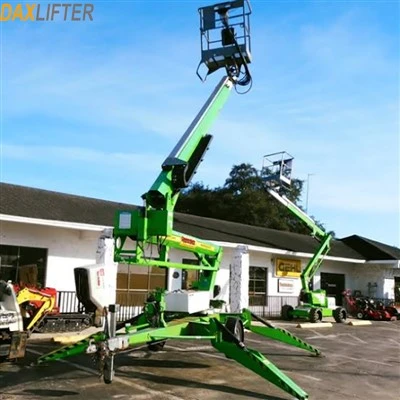
Built with an integrated road trailer chassis, heavy-duty axles, hitch and braking system. No heavy special transporter is required; it can be towed directly by regular commercial pickups, service trucks or SUVs.
Core design focus: Easy transportation and fast setup for multi-site mobile operations
Stability system: Equipped with extendable hydraulic outriggers with auto-levelling function. Outriggers level the chassis before boom lifting, enabling stable work on grass, dirt, driveways and gentle slopes.
Alternative names: Trailer-mounted boom lift, trailer boom lift, trailed aerial work platform.
Self-propelled Boom Lift
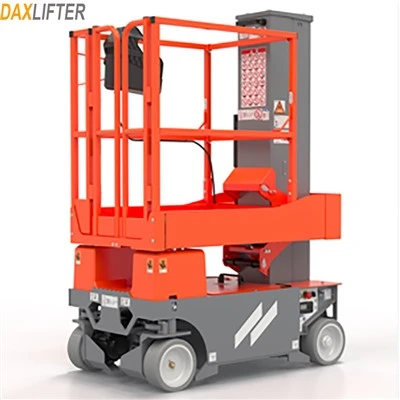
Comes with on-board drive and steering. Operators can drive and steer the whole machine from inside the basket.
Core design focus: Frequent repositioning within one large jobsite
Stability system: Relies on heavy counterweight and wide wheelbase. It can travel and steer while elevated, with no need to deploy outriggers.
Alternative names: Driveable boom lift, self-driving aerial lift, rough terrain boom lift.
Quick Comparison of Key Performance
Purchase cost: Towable boom lifts require lower capital investment; self-propelled boom lifts carry a much higher upfront price. Transport flexibility: Towable models have a clear advantage and can be towed by ordinary pickups. Self-propelled units need flatbed or heavy trailers for relocation. On-site deployment: Towable lifts use hydraulic outriggers for fast levelling. Self-propelled models require no outriggers and can drive straight to work once on site. On-site movement: Towable lifts need the boom lowered before towing to a new position. Self-propelled units can reposition while the platform is elevated. Maintenance expense: Towable lifts feature simpler mechanical structures with fewer failure points and lower service costs. Self-propelled models have higher maintenance demands for drive, powertrain and engine systems. Ground protection: Lightweight towable lifts plus outrigger pads minimise damage to lawns. Heavy self-propelled machines may leave tyre ruts on surfaces. Application scenarios: Towable lifts suit contractors and maintenance providers doing daily multi-site jobs. Self-propelled lifts fit long-term large commercial projects on a single site.
Total Cost of Ownership: Financial & Operational Evaluation
Equipment investment should not be judged solely by the invoice price. True ROI depends on upfront cost, logistics, insurance, wear-and-tear maintenance and residual resale value.
Initial purchase: Towable boom lifts cost less; self-propelled machines carry a high price tag. Transport method: Towable lifts can be towed by your existing pickup fleet. Self-propelled units depend on heavy flatbed or tilt-bed trucks. Transportation cost: Towable models leverage your in-house vehicles with almost no extra freight cost and full schedule control. Self-propelled lifts incur high transport fees and often require third-party trucks and licensed drivers. Maintenance complexity: Towable lift service mainly covers hydraulics and trailer brakes, simple to maintain. Self-propelled units need servicing for hydrostatic drive, 4WD and engines, requiring heavier workload. Insurance premium: Lighter towable lifts have lower insured value and attract cheaper commercial insurance. Self-propelled machines with higher value mean higher insurance costs. Resale value: Towable lifts maintain steady market demand within tree care, property maintenance and equipment rental sectors, delivering strong residual value. Self-propelled lifts have medium residual value, heavily affected by engine hours and wear on drive components. Jobsite mobility: Towable lifts offer moderate mobility and must be towed for relocation. Self-propelled lifts provide excellent mobility, with operators driving directly from the basket. Best ROI scenarios: Towable lifts fit small fleets, mobile contractors and rental companies. Self-propelled lifts suit large general contractors and long-term on-site projects.
Breakdown of Key Cost Drivers
Upfront capital outlay: Towable boom lifts allow small teams and independent contractors to add aerial working capacity without tying up large working capital.
Logistics savings: Towing with your existing service pickups eliminates third-party trailer fees, giving full control over travel schedules.
Insurance advantages: Lower gross vehicle weight and replacement cost reduce road transit risks and keep insurance premiums under control.
Servicing simplicity: No complex drive motors or off-road steering assemblies. Routine checks cover hydraulic pumps, boom hoses and trailer brakes with minimal labour.
Resale potential: Tree care, municipal property and rental markets maintain consistent demand. Well-maintained towable lifts retain solid second-hand value.
Real-world Business Case Analysis
Performance differences translate directly to on-site productivity. Below are three common operational scenarios for comparison.
Scenario 1: Tree Care & Arboriculture Services
A tree service company visits four residential yards daily for tree pruning, roughly two hours per job before moving to the next customer.
Towable lift performance: Towed rapidly between residential sites by in-house pickups with nearly zero transport cost. Wide outrigger pads spread weight to avoid lawn damage.
Business benefit: No heavy trailer coordination, fast on-site setup. Teams can complete one extra residential job per day, boosting billable revenue by up to 25%.
Scenario 2: Multi-building Campus Facility Maintenance
A facility management team maintains 12 buildings across a campus, including facade inspection, roof repairs, gutter cleaning and lighting replacement across dispersed work points.
Towable lift performance: Technicians hitch the unit to service trucks, drive to target buildings and deploy auto-levelling outriggers. Multiple building sites can be covered within half a day.
Business benefit: Simple inter-building transport raises equipment utilisation and cuts idle time.
Scenario 3: Large Commercial & Industrial Installation
A general contractor builds a 100,000 sq ft steel-frame distribution centre. Aerial welding, pipe routing and electrical panel installation run continuously over weeks on large concrete floors.
Self-propelled lift performance: Operators reposition the machine horizontally while working at height, no boom retraction required. Work station changes take only minutes.
Business benefit: Eliminates repeated setup downtime, saving substantial labour hours over long-duration continuous projects.
Four Self-assessment Questions to Choose the Right Boom Lift
Do not focus on which machine is "better". Answer these four strategic questions based on your business to identify the correct model:
How many job sites do you visit weekly? Multiple sites daily/weekly → Prioritise towable lifts to remove waiting time and trailer expenses. Single site for weeks or months → Choose self-propelled boom lifts for superior on-site mobility.
Does your existing fleet support heavy equipment transport? Fleet mainly consists of ½-ton, ¾-ton pickups and regular service trucks → Towable lifts connect directly to your existing vehicles with no extra transport purchases. Own flatbed or tilt-bed trucks plus licensed hauling staff → You have the infrastructure to transport self-propelled lifts.
Do you need frequent workstation repositioning? 1–3 hours per location before moving → Towable lifts with hydraulic auto-levelling deliver sufficient deployment speed. Relocate every 5–10 minutes along walls or roofs → Self-propelled lifts allow movement at height and save repeated levelling work.
Is your priority lowering total ownership cost or maximising on-site productivity? Target lower purchase and maintenance costs with faster payback → Select towable aerial work platforms. Long continuous work on open industrial sites, productivity first → Choose self-propelled boom lifts.
Quick Selection Guide
If your business handles 2–5 residential or scattered service calls each day, a towable boom lift is the preferred option. It transfers quickly without specialised heavy haulers. If your company already operates light pickup and service truck fleets, towable models reuse your vehicles with no added transport expense. For sites with lawns, gardens, slopes or soft ground, the lightweight towable unit plus outrigger pads protects the original ground surface. If you plan to expand equipment rental services, towable lifts have a low entry cost and strong rental demand for higher ROI.
For projects over 50,000 sq ft running multiple weeks or longer, self-propelled boom lifts are recommended. They excel at continuous heavy-duty work with greater load and runtime capacity. When workstation relocation is needed every few minutes, self-propelled lifts travel at height without lowering the boom or re-levelling outriggers, saving significant on-site time.
DAXLIFTER Towable Boom Lift Product Highlights
After deciding the lift type, selecting a reliable manufacturer guarantees stable equipment, timely after-sales support and long-term value. DAXLIFTER commercial-grade towable boom lifts are engineered for tough site conditions, offering maximum working height up to 22 m (72 ft), covering residential tree trimming, property maintenance and mid-sized construction.
Broad working parameters: platform heights ranging from 10–20 m, maximum working height 12–22 m, maximum horizontal outreach 5.8–12 m, able to work over fences and barriers. Reliable load capacity: maximum platform capacity of 200 kg, accommodating operators, heavy tools and consumables together. One-touch hydraulic auto-levelling outrigger system: chassis levelled within seconds for safe setup on lawns, slopes and soft soil. Pickup-tow design: heavy-duty road trailer chassis plus standard ball hitch, towable by regular commercial pickups and service vehicles. Compact narrow body: slim chassis passes standard factory gates, narrow residential side yards and urban alleyways for tight site access.
For independent contractors, property maintenance firms and rental companies, DAXLIFTER towable boom lifts deliver flexible transport and low total ownership cost, making them a cost-effective solution for multi-site mobile aerial operations.
Contact: WhatsApp / Phone: +86 15192782747 Email: sales@daxlifter.com