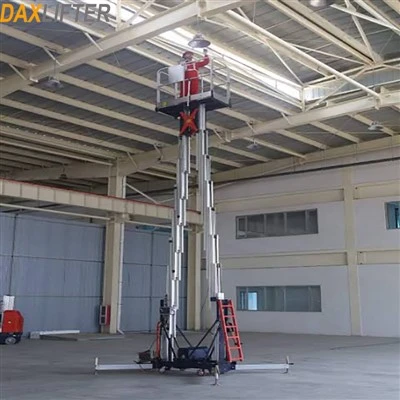
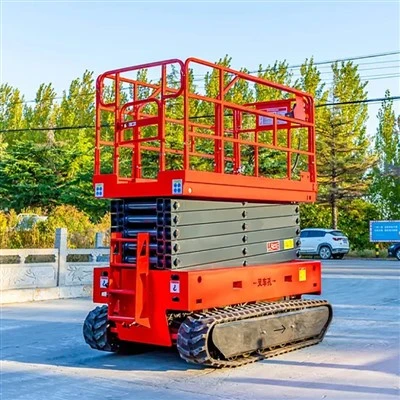
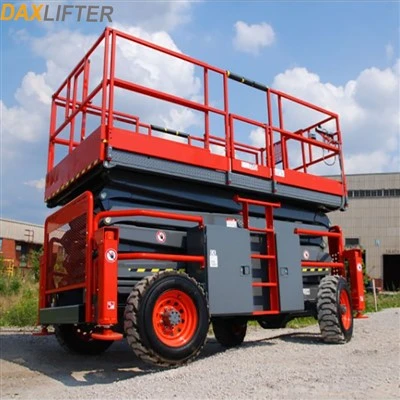
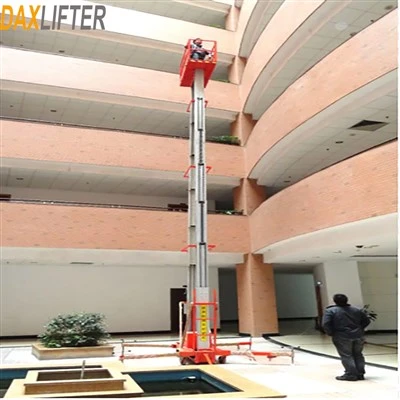
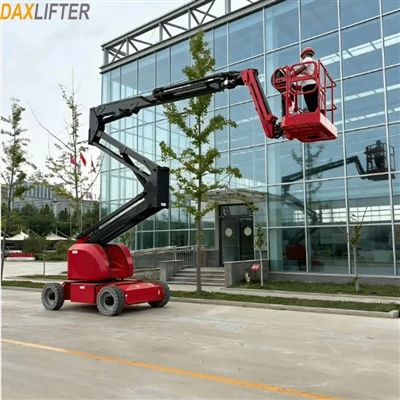
Within aerial‑work machinery, rough‑terrain scissor lifts are not merely upgraded versions of standard platforms. They are purpose‑built engineering units for rugged sites, harsh surroundings and demanding cross‑country mobility. Their core value emerges when conventional lifts cannot gain entry, maintain stability or sustain continuous work: rough‑terrain scissor lifts safely deliver operators and materials to target elevations.
For construction sites, mining sites, oilfields, power‑emergency repairs, municipal maintenance and disaster‑response rescue, maximum working height is not the decisive test. Real‑world performance hinges on whether the machine can physically reach the work point. Equipped with oversized tyres, elevated ground clearance, powerful powertrain and rigid scissor linkage, rough‑terrain scissor lifts deliver outstanding traversal over rutted, muddy, stony and sloped terrain. They minimise relocation obstacles and lower requirements for hard‑paved working surfaces.
1. Working Principle: scissor‑link load‑bearing, hydraulic actuation, stability‑oriented design
A rough‑terrain scissor lift consists of heavy‑duty scissor arms, working platform, hydraulic assembly, power unit and off‑road chassis. Hydraulic cylinders drive the scissor mechanism to extend, lifting the platform vertically and smoothly. For descent, control manifolds regulate oil return to ensure slow, controlled lowering motion.
Compared with general‑purpose aerial platforms, it prioritises robust load‑carrying performance and site adaptability. Fully deployed scissor arms form multi‑point support. Spacious platform decks support multi‑person crews and accommodate hand‑tools, pipes, lighting fixtures and inspection instruments at height.
Hydraulic circuits integrate safety components including burst valves, counterbalance valves and overflow valves. In case of hose rupture or system malfunction, the platform avoids free fall and descends at a controlled low speed, granting operators time for response and evacuation. This capability proves critical in unattended field environments such as mines and power‑repair zones.
Multiple power options are available: diesel engines, AC electric motors and DC drive motors. Most units incorporate a manual hydraulic pump for emergency descent. Versatile power configurations adapt to varied environments: electric drive for powered sites, diesel for off‑grid wilderness zones, and backup manual actuation for safe platform retraction during unexpected power loss.
2. Practical advantages: real‑site usability over superficial specification stacking
2.1 Superior traversal across uneven ground
Chassis and tyre specifications far exceed those of indoor or flat‑floor scissor platforms. Large‑diameter off‑road tyres, widened wheel track and responsive steering enable operation over gravel, mud, potholed ground and moderate gradients.
On unhardened construction zones, mine gateways, sandy oilfield ground and disaster‑relief sites, machinery must travel while searching for work locations. Standard lifts often demand steel‑plate laying or ground levelling beforehand. Rough‑terrain scissor lifts approach task points more directly and cut preparatory work hours.
2.2 Smooth lifting motion suited for precision‑sensitive assignments
Aerial‑work priorities extend beyond sheer lifting height; steady platform behaviour matters greatly. Pipeline inspection, equipment fitting, facade repair, street‑lamp replacement and steel‑structure diagnostics all demand stable operator footing aloft.
Rigid scissor frameworks and hydraulic transmission deliver gentle lift/lower cycles with minimal sway. Expansive platform decks simplify operator positioning, tool staging and material transfer, ideal for prolonged stationary overhead tasks.
2.3 Site‑oriented multi‑layer safety safeguards
Construction‑site hazards mostly stem from unforeseen events: overloading, power failure, hydraulic‑hose damage, ground subsidence and accidental collision all amplify overhead‑work risks.
Standard safety packages comprise overload protection, emergency descent controls, manual release valves, perimeter guardrails, anti‑slip decking and warning systems. Upon detecting excess load, the system blocks hazardous movements and triggers alerts. During blackouts or engine shutdowns, emergency circuits enable slow platform descent and prevent personnel entrapment or risky improvisation.
2.4 Expandable working envelope for diverse operational modes
Industry requirements vary widely: building‑construction may demand heavy‑tool payloads; power‑restoration needs fast movement between dispersed points; oil‑site maintenance calls for non‑stop shifts; municipal street‑lamp servicing requires tight‑space positioning.
Rough‑terrain scissor lifts support rich customisation. Platform extensions increase horizontal outreach. Rated capacities range up to heavy‑load levels. Users select configurations matched to working height, payload, ground conditions and power‑source preferences.
2.5 Enhanced durability for harsh continuous‑operation environments
Mines, oilfields, desert zones, coastal yards and disaster‑response locations impose severe demands on hardware. Dust, rain, humidity, corrosive agents and extreme temperatures degrade hydraulics, electrics and metal structures.
Rough‑terrain scissor lifts adopt anti‑corrosion coatings, sealed hydraulic assemblies, dust‑proof & water‑resistant electrical housings and reinforced chassis. Compared with ordinary lifting platforms, they withstand prolonged exposure to hostile surroundings and satisfy round‑the‑clock operational demands.
3. Typical application scenarios
Power‑network emergency repair: rapid access to complex topography
Mountain transmission lines, remote substations, wind‑ and solar‑farm sites frequently feature narrow tracks, steep gradients and uneven terrain. Conventional vehicles struggle to approach fault locations, forcing crews to rely on manual climbing or fragmented small‑equipment transport.
High‑ground‑clearance, powerful rough‑terrain scissor lifts negotiate difficult ground and deliver maintenance crews directly to overhead work positions. For line inspection, insulator replacement, pylon servicing and fault diagnosis, they eliminate lengthy scaffolding erection and reduce fall risks from manual climbing.
Oilfield & mine maintenance: off‑grid, dusty, continuous‑shift environments
Oil‑ and mine‑site requirements are straightforward: mobility, robustness and sustained runtime. Sandy ground, stony surfaces, heavy dust and remote power‑free areas call for high environmental tolerance.
Diesel‑powered rough‑terrain scissor lifts support uninterrupted operation. Sealed hydraulics resist dust ingress and reinforced chassis endure frequent relocation and impact. They deliver stable elevated bases for oil‑plant inspection, mine‑drift servicing, conveyor upkeep and overhead detection assignments.
Building‑construction: combined personnel‑and‑material overhead handling
Especially during early‑phase construction before site hard‑completion, cross‑site mobility is vital. Rough‑terrain scissor lifts manoeuvre across mud, ruts and material‑stock zones for crew transport, tool transfer, pipe installation, formwork adjustment and steel‑structure checks.
Superior mobility outperforms static scaffolding. After finishing one work station, the unit self‑propels onward without repeated erection and dismantling, well‑suited for multi‑point, phased and recurring overhead work.
Emergency rescue: aerial‑work support at disaster‑stricken sites
Flood, earthquake, landslide and bridge‑incident zones often suffer destroyed road infrastructure, hindering rapid deployment of rescue hardware. Rough‑terrain scissor lifts serve as elevated bases for bridge assessment, building‑structure evaluation, power‑line recovery, trapped‑person observation and obstacle clearance.
Beyond simple lifting, they furnish relatively stable overhead anchorage within unstable disaster zones. Rescue teams gain faster access to danger zones, clearer structural risk evaluation and improved execution efficiency.
Municipal works & arboriculture: flexible urban and green‑space operations
Street‑lamp upkeep, traffic‑sign installation, landscape‑light maintenance, tree pruning and urban‑greening retrofits also need height‑access hardware. Though terrain may not be extreme, manoeuvrability, stability and low‑noise output are essential for deployment within alleyways, green belts and car‑park peripheries.
Rough‑terrain scissor lifts operate off paved roads and reduce dependence on finished surfaces. For landscape projects, they assist precise overhead work around mature trees and ornamental installations.
4. Selection guidance: look beyond working height; evaluate real‑world operating conditions
Key practical criteria when specifying rough‑terrain scissor lifts:
Working height & platform payload Working height defines machine size; rated capacity determines whether personnel, tools and supplies can be carried concurrently. Solely choosing by maximum height risks insufficient real‑world payload performance.
Site traversal requirements Mud‑prone, stony, sloped or low‑lying sites prioritise high‑clearance, large‑tyre four‑wheel‑drive models. Relatively flat ground permits more cost‑effective configurations.
Power‑unit selection Electric drive suits locations with stable grid supply and noise‑restriction rules. Diesel power fits off‑grid wilderness, emergency repair, mine and oil‑field tasks. Emergency descent mechanism shall be treated as a mandatory check‑item.
Platform expandability For large horizontal outreach, evaluate platform extensions and guardrail set‑ups. Frequent relocation draws attention to machine weight, overall dimensions and turning radius.
Safety features & total‑cost‑of‑ownership Hydraulic components (burst valve, counterbalance valve), overload protection, emergency lowering, anti‑slip deck and warning systems govern long‑term operational safety. For high‑hazard environments, these safety options must not be compromised.
The core strength of rough‑terrain scissor lifts lies in the combination of overhead‑work capability and off‑road mobility. More than merely lifting personnel upwards, they deliver stable, safe, mobile aerial‑work platforms where standard machinery cannot operate.
For building construction, mining, oil‑site servicing, power emergency response, disaster rescue, municipal engineering and arboriculture, rough‑terrain scissor lifts solve challenges beyond the reach of scaffolding, truck‑mounted booms and ordinary scissor platforms. Their value manifests not only on datasheets, but in real‑site accessibility, operational stability and sustained performance.
DAXLIFTER specialises in aerial‑work equipment. Custom‑tailored solutions are available for varied working heights, payload requirements, site conditions and power‑source specifications, together with ongoing technical support and after‑sales service. For model consultation, configuration review or custom quotation requests, please contact:
Tel / WhatsApp: +86 15192782747
Email: sales@daxlifter.com